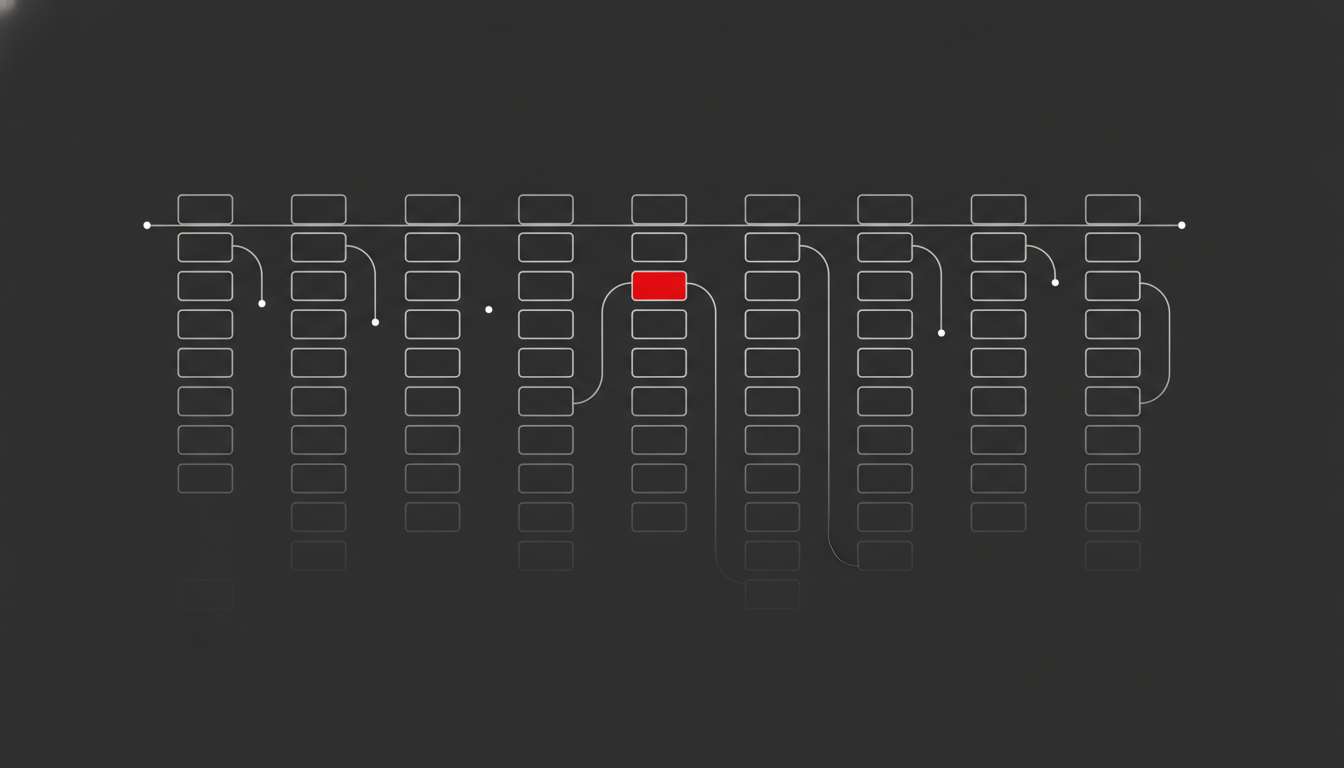
SEO automation is the practice of replacing a recurring human SEO action with a scheduled, rule-based, or AI-driven process. Unlike a one-off script, real SEO automation runs continuously and produces an output someone acts on — which means the important question is not what can be automated but what should be, and at which layer.
According to DataForSEO (2026), “seo automation” draws roughly 1,900 US searches a month at a keyword difficulty of 14 — high demand, almost no serious competition. The reason the difficulty is that low is that the entire first page is vendor content. Two of the top ten organic results for the term are Reddit threads asking what can realistically be automated, one with over 130 comments — a reliable signal that the commercial content is not answering the question people are actually asking.
Google’s spam policies (Search Central, current guidance) target content produced primarily to manipulate rankings regardless of whether a human or a model produced it — which puts a hard ceiling on how far the content end of automation can go.
Here is the framework I use with clients, and where I have watched it go wrong.
What SEO Automation Actually Is (And What It Isn’t)
SEO automation is not a category of software. It is a decision about which recurring actions leave a human’s hands.
Vendors blur this deliberately. A rank tracker, a crawl scheduler, an AI writing tool, and an agent that edits your live title tags all get sold under the same label, and they carry wildly different consequences when they misfire. A rank tracker that breaks costs you a stale dashboard. An execution agent that breaks costs you 400 rewritten title tags and a traffic drop you will spend a quarter diagnosing.
The useful distinction is not tool versus tool. It is what happens when the output is wrong.
If a wrong output costs five minutes of review, automate it aggressively. If a wrong output goes live on a page that ranks, keep a person in the loop. Every sound SEO workflow automation decision follows from that single test.
The Four Layers of SEO Automation
Every SEO task sits in one of four layers, and risk rises sharply as you move up.
Layer 1 — Monitoring. Detecting that something changed. Crawl diffs, rank tracking automation, Search Console anomaly alerts, uptime and Core Web Vitals checks, log file parsing, broken link detection. Output is a notification. Wrong output costs a false alarm.
Layer 2 — Analysis. Turning changes into explanations. Keyword clustering, cannibalisation detection, SEO reporting automation, internal linking candidate lists, competitor gap analysis. Output is a document. Wrong output costs a review cycle.
Layer 3 — Production. Making things that need approval. Content drafts, meta descriptions, schema markup, redirect maps, brief generation. Output is a draft. Wrong output costs an editor’s afternoon.
Layer 4 — Execution. Writing to the live site. Auto-publishing, automated on-page edits, live redirect deployment, programmatic page generation at scale. Output is a change your users and Googlebot both see. Wrong output costs rankings.
Layers 1 and 2 are safe to run unattended. Layer 3 is safe with a review gate. Layer 4 is a governance decision that most teams make as a software purchase, which is precisely why it goes wrong.
What to Automate First: The Boring Layer Nobody Buys
In my experience auditing sites, the pattern is almost always the same: the content pipeline is automated and the monitoring layer is a person opening Search Console when someone complains about traffic.
That is backwards, and it is expensive.
Automated technical SEO monitoring is the highest-return automation available because it compresses detection time. A template-level regression — a noindex shipped in a release, a canonical pointing at staging, an internal link block dropped from a layout — is cheap to fix on day one and brutal to fix on day ninety. The fix does not get harder. The recovery does.
Start here:
- Daily crawl diffs on templates, not pages. You do not need to crawl 200,000 URLs nightly. Crawl one representative URL per template and alert on any change to title, canonical, robots directives, or internal link count.
- Search Console anomaly alerts by page group. Site-wide clicks hide everything. Segment by directory or template and alert on deviation, not on absolute numbers.
- Log file monitoring for crawl waste. Automated parsing surfaces bot hitting parameter URLs or paginated dead ends long before it shows up as an indexing problem.
- Indexation delta. Track submitted versus indexed by sitemap segment. A quiet drift here precedes almost every traffic decline I get called about.
None of this is glamorous and no vendor markets it hard, because there is no AI story in a diff report. It is also the automation that has saved my clients the most money.
If you want this built properly around your stack, that is the core of what a technical SEO engagement should deliver in the first month.
What Breaks When You Automate the Judgement Layer
The failure mode is consistent, and it is not that the automation produces garbage. It is that it produces plausible output at a rate nobody can review.
Three patterns I see repeatedly:
Mass meta rewriting. A tool rewrites title tags across a site to hit an “optimisation score”. Scores go up, CTR goes down, and because the change was gradual and site-wide, nobody attributes the decline to it for months. There is no rollback because there is no change log.
Unreviewed publishing. Content ships on a schedule with no editorial gate. It does not get penalised dramatically — it just never ranks, and it dilutes the topical signals of the pages that do. You end up paying to make your own site harder to understand.
Automated redirect deployment. A migration script generates and deploys redirects without a human checking the mapping logic. Chains, loops, and mass redirects to the homepage all get shipped at once. This is the single most damaging automation failure I have had to unpick, and it is always the one that felt safest going in.
The common thread: each of these automates a decision, not a task. Choosing which title tag serves a page is a decision. Detecting that a title tag changed is a task. Automate the second one, ruthlessly. Route the first through a person.
Google’s own spam policies are explicit that scaled content abuse is judged on intent and quality, not on authorship. Automation does not change what gets penalised. It changes how fast you can produce the thing that gets penalised.
The SEO Automation Decision Framework
Run any candidate task through these five steps before you automate it. This takes about ten minutes per task and it is the entire methodology.
-
Classify the layer. Is the output a notification, a document, a draft, or a live change? Layer 1 and 2 proceed automatically. Layer 3 needs a named reviewer. Layer 4 stops here until steps 4 and 5 are answered.
-
Price the wrong output. Ask what a bad result actually costs in time and money. Five minutes of review is a green light. A ranking drop discovered a quarter later is not. If you cannot price it, you do not understand the task well enough to automate it.
-
Check reversibility. Can you undo this in under an hour without a developer? If the answer is no, you need a change log before the automation ships, not after. Every automated write should record what changed, when, and what the previous value was.
-
Define the human gate. Name the person who approves, and define what they are checking for. “Someone reviews it” is not a gate. “The content lead approves every draft against the brief before publish” is.
-
Set the kill switch. Decide in advance what signal stops the automation, and who can stop it. A monitoring automation that fires 200 false alerts a week gets muted, which is functionally the same as not having it. An execution automation with no kill switch is an outage waiting for a trigger.
If a task passes all five, automate it. If it fails step 3 or 4, you have found a workflow problem that automation would amplify rather than solve. Fix the workflow first.
That sequencing is usually the highest-value hour in an SEO audit, because it tends to reveal that the bottleneck is a review process, not a missing tool.
Where AI SEO Agents Fit — And Where They Don’t
The 2026 pitch is agentic: models that plan and execute SEO tasks end to end. The capability is real. The framework above does not change because of it.
An AI SEO agent is still operating at one of the four layers, and the risk still comes from the layer, not from the model. An agent doing Layer 2 analysis is a genuinely good deal — it reads a crawl, a log file, and a Search Console export together, which is exactly the cross-referencing that used to eat a consultant’s Tuesday. An agent doing Layer 4 execution on a live site is the mass meta rewrite problem with better prose and more speed.
Two practical guardrails:
- Give agents read access broadly and write access narrowly. Analysis needs everything. Execution needs one scoped permission and a log.
- Never let an agent be the only record of what it did. If the change log lives inside the agent’s own context, you cannot audit it after the fact.
The scale problem this creates is not new, either. Ahrefs’ widely cited study found that 90.63% of pages get no organic traffic from Google at all. Publishing capacity has never been the constraint in SEO. Making things worth ranking is, and no amount of content SEO automation changes that arithmetic.
Who Owns SEO Automation Inside a Team
Automation without an owner degrades. Alerts get muted, integrations break silently after an API change, and six months later the team believes it has monitoring it no longer has.
Assign one person to review the automation stack monthly against three questions: what fired, what should have fired and didn’t, and what nobody acted on. That third question kills more automations than the first two, and it should — an alert nobody acts on is noise with a maintenance cost.
For in-house teams, this sits naturally with whoever owns the technical backlog. For smaller teams without that role, it is a good candidate for an outside SEO consultant on a light retainer, precisely because it is a monthly hour of judgement rather than a full-time job.
The teams that get real leverage from SEO automation are not the ones with the most tools. They are the ones who automated detection completely, automated reporting completely, drafted with AI under review, and kept a human on everything that ships. That order is the whole answer.
Frequently Asked Questions
Can ChatGPT do SEO?
ChatGPT can do the production work in SEO, not the decision work. It writes drafts, clusters keywords, generates schema, and explains a crawl error faster than a junior can. What it cannot do is decide which of your 400 flagged issues actually affects revenue, because that requires knowing your business model, your margins, and which pages convert. Use it as capacity, and keep the prioritisation with a person.
Will SEO be replaced by AI?
No, but one specific layer of SEO work is being replaced: the repeatable production tasks that used to fill a junior’s week. Manual crawl triage, first-draft writing, and hand-built reports are disappearing as billable work. The strategic layer — deciding what to build, what to kill, and what to fix first — is getting more valuable, not less, because the cost of executing a bad decision has dropped to almost zero.
What is the best automated SEO tool?
There is no single best automated SEO tool, because the four layers of SEO automation solve different problems and most teams only need two of them. Monitoring and reporting tools pay back fastest and carry almost no risk. Execution tools that write changes to your live site are a governance decision, not a software purchase, and should not be bought until you have approval, change-logging, and rollback in place.
Can AI do SEO for my website?
AI can run the monitoring and analysis half of SEO on your website unattended, and it can draft the other half for a human to approve. Where it fails is unsupervised publishing: Google’s spam policies target content produced primarily to manipulate rankings, regardless of whether a human or a model wrote it. If nobody reviews the output before it ships, you are automating a liability rather than a workflow.
Can a beginner do SEO?
Yes, and automation makes the starting point easier than it was five years ago because the monitoring layer is now nearly free to set up — Search Console alone covers most of it. What automation does not shortcut is judgement, which is the part that takes years. A beginner running automated audits will get an accurate list of 300 problems and no reliable way to know which three matter.
The short version: SEO automation pays when it points at detection and reporting, and costs when it points at decisions. Automate the boring layer completely, keep a named human on anything that writes to your live site, and revisit the stack monthly. If you want a second opinion on where your own automation line should sit, that is exactly the kind of thing I do as a freelance SEO consultant.