Search intent optimization is the practice of matching a page’s content, format, and depth to what searchers actually want when they type a query — not to the keyword itself. It is the single most common reason technically sound pages fail to rank, and the fastest ranking fix available in 2026. If your page targets the right keyword but answers the wrong question, Google will quietly pass it over for a competitor that understood the intent behind the search.
Here is the shift most site owners miss. Google no longer ranks the page that mentions the keyword most. It ranks the page that best satisfies the job the searcher is trying to get done. Search intent optimization is how you reverse-engineer that job and build a page around it.
What Search Intent Actually Is
Search intent — also called user intent or keyword intent — is the underlying goal behind a search query. Someone typing “how to fix a slow website” wants to learn. Someone typing “best SEO consultant Valencia” wants to compare and hire. Same broad topic, completely different jobs, and Google serves completely different results for each.
Google has spent years getting better at inferring intent, and its ranking systems now treat intent match as a threshold you either clear or you don’t. You can have the strongest backlink profile in your niche, flawless technical SEO, and a page that loads instantly — and still lose to a thinner competitor whose page simply matches intent better.
In my experience auditing sites, intent mismatch is the most underdiagnosed ranking problem there is. Teams obsess over word count and backlinks while the real issue is that they published a 3,000-word essay for a query where searchers wanted a five-item comparison table.
The Types of Search Intent
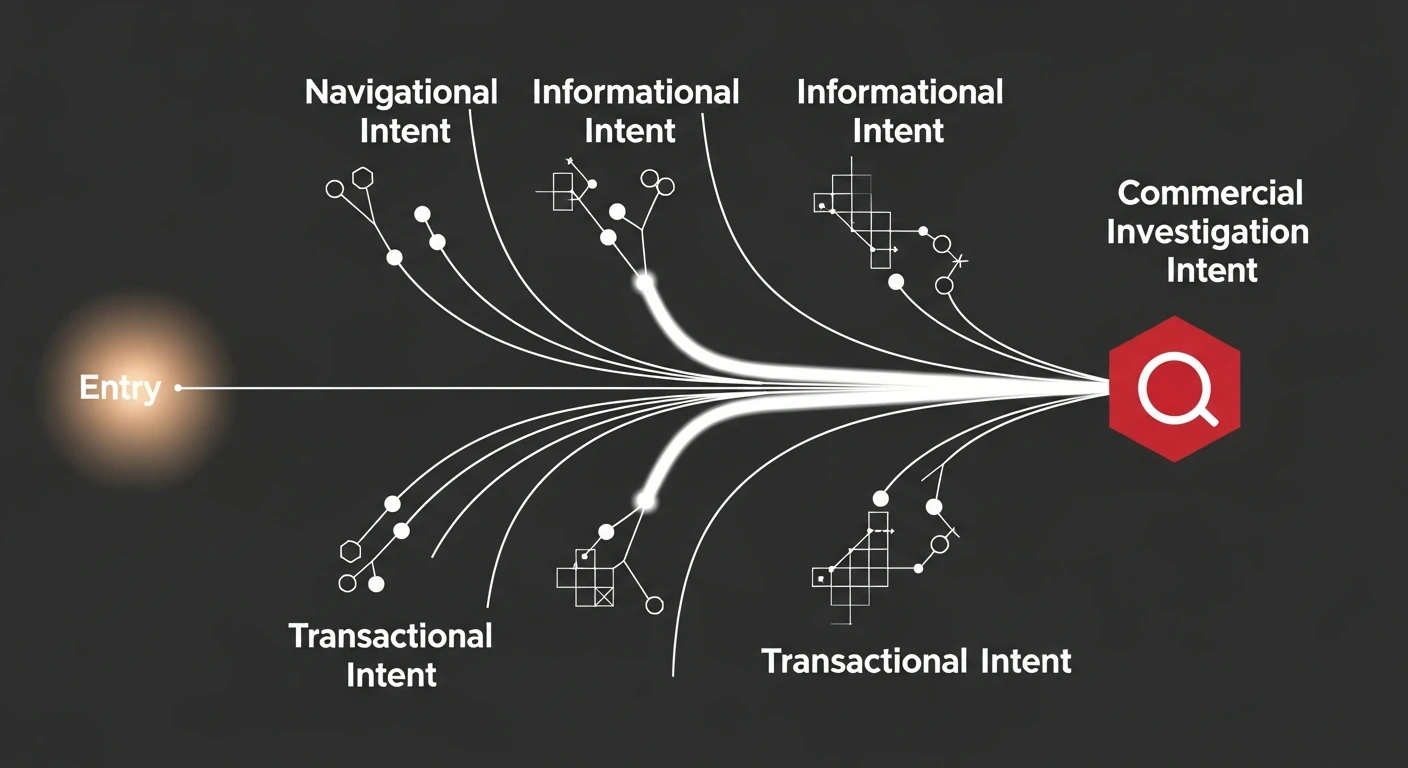
Every query maps to one dominant intent. The classic model has four types, and in 2026 most practitioners add two more.
The four classic types
- Informational — the searcher wants to learn something. “What is crawl budget”, “how to write meta descriptions”. These dominate search volume.
- Navigational — the searcher wants a specific site or page. “Search Console login”, “seobeni pricing”.
- Commercial — the searcher is comparing options before a decision. “Best CRM for startups”, “freelance SEO vs agency”. High-value, pre-purchase.
- Transactional — the searcher is ready to act. “Hire SEO consultant”, “buy Ahrefs subscription”.
The two 2026 additions
- Local — intent tied to a place: “SEO agency near me”. Google serves a map pack, not ten blue links.
- Generative — queries where users expect a synthesised answer from an AI engine rather than a list of links. This is the type reshaping informational SEO fastest.
The distribution matters for strategy. A large-scale query analysis by SE Ranking put the 2025 split at roughly 53% informational, 32% navigational, 15% commercial, and under 1% transactional. Informational queries are where the volume lives — but as you will see, they are also where the click is disappearing.
Why Intent Mismatch Kills Rankings
An intent mismatch happens when the format or angle of your page does not match what searchers — and therefore Google — expect for that query. It is the reason strong pages plateau.
Consider a query like “email marketing software”. The SERP is wall-to-wall comparison pages and category listings, because the intent is commercial. If you publish a beginner’s guide to email marketing and target that keyword, you are competing in the wrong format. Google has already decided what wins that query, and it is not a tutorial. Your guide might rank beautifully for “how does email marketing work” — a genuinely informational query — but it will never crack the top three for the commercial term.
This is why keyword research without intent analysis is dangerous. Two keywords can have identical volume and difficulty and demand completely different pages. Google’s own guidance on creating helpful content is essentially a long argument for matching content to what people actually need — reliability and usefulness for a specific purpose, not keyword coverage for its own sake.
The most reliable fix I see across projects is not writing more. It is rewriting the page in the format the SERP demands, or splitting one confused page into two intent-specific ones. That is often the difference between page two and the top three, and it frequently surfaces during a content audit rather than in the original keyword plan.
How to Diagnose Search Intent from the SERP
You do not guess intent. You read it off the search results, because the ranking pages are Google’s own verdict on what the query means. Here is the exact process I use.
- Search the query in an incognito window. Strip out personalisation and, ideally, set the location to your target market so the SERP reflects a real searcher.
- Classify the dominant content type in the top ten. Are they guides, product pages, comparison articles, tools, or videos? The majority format is the intent Google has validated. If eight of ten results are listicles, your essay will not win.
- Read the SERP features. An AI Overview, featured snippet, and People Also Ask block signal informational intent. Shopping results, ads, and product carousels signal commercial or transactional intent. A map pack signals local intent.
- Check content depth and angle. Are the top results 800-word quick answers or 4,000-word pillar pages? Do they lead with a definition, a comparison table, or a buy button? Match the depth, not just the topic.
- Note the modifiers in the ranking titles. Words like “best”, “vs”, “review”, “how to”, and “template” reveal the sub-intent you need to satisfy.
Do this for every priority keyword before you write a single word. It takes five minutes per query and prevents the most expensive mistake in content SEO: building the wrong page well. When you scale this across a topic, intent mapping becomes the backbone of your content strategy.
How to Optimise a Page for Search Intent
Once you know the intent, search intent optimization becomes concrete. The goal is to make your page the most obvious best answer for the specific job behind the query.
Match the format first. If the SERP is comparison pages, build a comparison page. If it is step-by-step guides, write the clearest step-by-step guide. Format alignment does more for rankings than any on-page tweak.
Answer the core question immediately. Lead with a direct, liftable answer in the first two or three sentences — this doubles as your featured snippet and AI Overview target. Do not bury the answer under 400 words of preamble.
Cover the sub-questions. People Also Ask and “related searches” show you the follow-up questions searchers have. A page that resolves the main query and its natural follow-ups satisfies intent more completely and holds the click.
Align the page’s job with your funnel. For commercial and transactional intent, the page should make the decision easy — clear comparisons, pricing, proof. Informational pages earn trust and can link deeper into your commercial pages, the way a strong consulting page sits one click from the guides that feed it.
Prune the mismatch. If a page targets a keyword whose intent it can never satisfy, either re-point it at the query it genuinely matches or split it. Forcing one URL to serve informational and transactional intent at once usually means it ranks well for neither.
Search Intent Optimization in the Age of AI Overviews
The biggest change to search intent optimization in 2026 is that ranking first no longer guarantees a click. AI Overviews now synthesise answers to broad informational queries directly on the SERP, above the organic results. For “what is search intent”, the AI answer often satisfies the searcher before they scroll.
The strategic response is to shift weight toward intent types where the click still has value. Click-through rates on broad informational queries have fallen sharply as AI answers absorb the demand, while commercial and transactional queries — where users still need to compare options and act — continue to send real traffic. Someone ready to hire or buy does not settle for a two-sentence AI summary. They click through to evaluate.
That does not mean abandoning informational content. It means writing it to be cited by AI engines — clear definitions, structured data, quotable statistics — and treating it as top-of-funnel authority rather than a direct traffic play. This is the overlap between classic intent work and generative engine optimization: both reward pages that answer a specific question unmistakably well.
The practical rule I now apply: for every informational cluster, identify the commercial and transactional queries downstream of it, and make sure those pages are your strongest. That is where search intent optimization converts into revenue in 2026, not just rankings.
Separating those intents cleanly is exactly what keyword clustering is for — if two queries return different SERPs, they need different pages, however similar the wording.
Common Search Intent Mistakes
- Targeting volume over intent. A high-volume informational keyword that AI Overviews have hollowed out is worth less than a lower-volume commercial keyword that still converts.
- Ignoring mixed-intent SERPs. When results are split between formats, build separate pages rather than a compromise that serves no one.
- Writing long because “long ranks”. Length is a symptom of thorough intent matching, not a cause of ranking. A concise page beats a padded one when the intent is a quick answer.
- Never re-checking intent. Intent drifts. A query that was informational in 2024 can become commercial as a market matures. Re-read the SERP during every content review.
Search intent optimization is not a one-time task on a checklist — it is the lens you apply to every keyword, every page, and every content decision. Get it right and the rest of your SEO works harder; get it wrong and even a technically perfect site underperforms. Read the SERP before you write, match the job behind the query, and prioritise the intents where a click still has value.
Frequently Asked Questions
What is search intent optimization?
Search intent optimization is the practice of matching a page’s format, depth, and angle to what a query’s searchers actually want — as revealed by the pages already ranking for it. It is not about keyword density. It is about giving Google a page that answers the specific job behind the search, whether that is learning something, comparing options, or buying. Get the intent wrong and no amount of technical polish will make the page rank.
How do I find the search intent of a keyword?
Search the keyword in an incognito window and read the top ten results as a group. The dominant format — guides, product pages, comparisons, tools — tells you the intent Google has already validated. Also read the SERP features: an AI Overview and People Also Ask signal informational intent, while shopping packs and ads signal commercial or transactional intent.
What are the main types of search intent?
The four classic types are informational (learn something), navigational (reach a specific site), commercial (compare before buying), and transactional (take action or purchase). In 2026 most practitioners add local intent and generative intent — queries where users expect an AI-synthesised answer rather than a list of links. Every keyword you target maps to one dominant type.
Can a single page rank for multiple search intents?
Rarely well. A page optimised for informational intent — a thorough how-to guide — will struggle to outrank dedicated product pages on a transactional query, and vice versa. When a keyword shows mixed intent in the SERP, it is usually better to build separate pages for each dominant intent and link them together than to force one page to serve everyone.
How has AI search changed search intent optimization?
AI Overviews now absorb much of the click on broad informational queries, so ranking first no longer guarantees traffic. The pages that still earn clicks are those matching commercial and transactional intent, where users want to compare and buy rather than read a summary. In 2026, intent optimization increasingly means prioritising queries where a click still has value and structuring content so AI engines cite you.