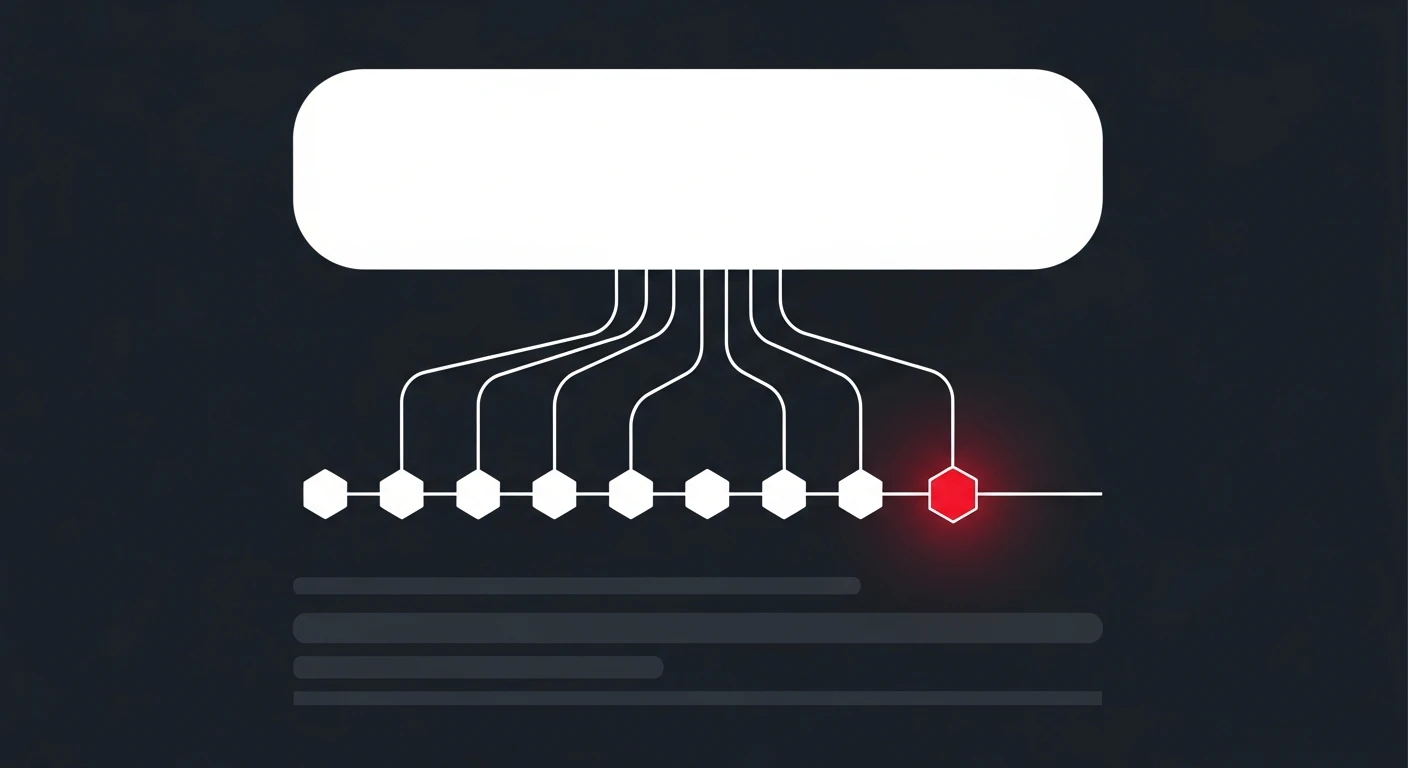
Google AI Overviews are the AI-generated answers that appear at the top of many search results, above the organic links, summarising a response and citing a handful of sources. To get your content cited, the page needs to rank well organically for the query and present its answer in a form the model can lift cleanly — a direct, self-contained statement near a clear heading. There is no submission form. Inclusion is earned through ranking and extractability, in that order.
This matters because the surface has moved. For a growing share of searches, the first thing a user reads is not your title tag — it is a synthesised paragraph that may or may not mention you. Ranking number one no longer guarantees the click, and in many cases it no longer even guarantees a place in the AI Overview. If you are not one of the cited sources, your competitor is.
This guide covers how AI Overviews actually select sources, what the traffic data really shows, and the concrete steps to make your pages citable. It is the Google-specific companion to my broader generative engine optimization playbook, which covers ChatGPT, Perplexity and Gemini.
What Google AI Overviews are and how they work
An AI Overview is a generative response Google composes at query time using its Gemini models, drawing on the live search index. It reads candidate pages that already rank for the query, extracts relevant claims, and stitches them into an answer with linked citations to the source pages.
The key mechanism to internalise: AI Overviews are grounded in the organic index, not a separate one. Google’s own documentation is explicit that there is no special markup or process to appear, and that the same core content guidance for Search applies. Your existing SEO is the foundation, not a parallel track.
That has a practical consequence. Everything that gets a page ranking — relevance, quality, authority, technical health — is still doing work, because a page that does not rank is not a candidate for citation in the first place. But ranking is necessary, not sufficient. Among pages that rank, the model favours the ones whose answers are easiest to extract and trust.
AI Overviews vs featured snippets
People conflate the two, and they are different. A featured snippet lifts one passage from one page and shows it verbatim with a single link. An AI Overview synthesises across multiple sources and generates new phrasing, citing several pages at once.
The optimisation instinct overlaps — clear, direct answers win both — but the AI Overview rewards being one strong voice among several, while the featured snippet is winner-take-all. If you already optimise for featured snippets, you are halfway there.
The traffic reality: what the data actually shows
Let’s be honest about the trade-off, because the vendor spin cuts both ways.
The click erosion is real. Ahrefs’ 2025 analysis of thousands of keywords found that the presence of an AI Overview was associated with a substantial drop in clicks to the top-ranking organic result — roughly a third fewer clicks for position one on affected queries. For purely informational searches where the answer fully satisfies intent, the drop is steeper.
At the same time, citation overlap with the classic top ten has weakened. Sources tracked through 2025 into early 2026 show that the pages Google cites in an AI Overview increasingly diverge from the pages ranking one through ten organically. In other words, a strong organic position raises your odds of citation but no longer locks it in.
The offset is qualification. Users who click through from an AI Overview citation have already seen a summary and chosen to go deeper — they arrive further down the funnel. Across the projects I’ve worked on, the pages that get cited tend to send fewer but noticeably better-qualified visitors, which is exactly the trade a serious business should be willing to make.
The mistake is treating this as a reason to panic or to disengage. It is a reason to shift what you measure — from raw sessions toward citations, qualified clicks and assisted conversions.
What actually drives inclusion in AI Overviews
Strip away the noise and a consistent pattern emerges across the queries I’ve studied. Five factors move the needle.
1. Organic relevance and ranking
This is the entry ticket. Because AI Overviews draw candidates from the index, pages that already rank in the top handful of positions for the query have by far the highest citation rate. Everything downstream assumes you have earned that relevance first. If you have not, the fastest path to AI Overview visibility is still a proper SEO audit and the fundamentals — relevance, intent match, technical health.
2. Answer extractability
The model prefers content it can lift with minimal reshaping. Pages that lead with a clear, one-to-three sentence answer directly under a descriptive heading get cited more than pages that bury the same answer three paragraphs into a narrative.
Front-load the answer. Then expand. This is the single most repeatable pattern I see separating cited pages from ignored ones.
3. Original data and named sources
Generative engines are biased toward content they can attribute with confidence. A proprietary statistic, a first-party benchmark, an original framework, a clearly sourced figure — these give the model something specific and defensible to cite. Pages that only rephrase what everyone else already published give it nothing distinctive to point to.
4. Entity clarity and structured data
The model needs to understand what your content is about at the level of entities, not just keywords. Clean schema markup — Article, FAQ, Organization, Product where relevant — clarifies those entities and relationships. Structured data does not force inclusion, but it makes discrete claims easier to extract and correctly attribute. Get the technical foundation right through solid technical SEO.
5. Topical and off-site authority
For anything in a Your Money or Your Life category — health, finance, legal — the model leans hard on trust signals. Established entity authority, consistent mentions across the web, and genuine expertise on the page all raise citation odds. This is where authority-building and content depth compound.
A practical framework to make pages citable
Here is the checklist I actually run when the goal is AI Overview inclusion. Apply it page by page, starting with the pages that already rank on page one but are not being cited.
- Confirm the query triggers an AI Overview. Search it. If Google shows no AI Overview for the query, this work is lower priority — focus on classic ranking instead.
- Confirm you rank in the top positions. No top-ten presence, no realistic citation. Fix ranking first.
- Identify the exact question the section answers. One page targets several sub-questions; each needs its own extractable answer.
- Front-load a direct answer of one to three sentences immediately under a descriptive H2 or H3 that matches the question.
- Back the answer with something original — a data point, a named source, a first-hand observation the model can attribute.
- Add or verify structured data so the entities and content type are unambiguous.
- Tighten the writing. Short sentences, one idea each, no hedging. Quotable prose gets quoted.
- Add a focused FAQ block targeting the People Also Ask questions around the topic, each answered in two to four sentences.
- Track citation status as its own metric and re-check after the next crawl cycle.
None of this is exotic. It is disciplined content structuring applied with the retrieval-and-synthesis pipeline in mind. The teams that win at AI Overviews are not chasing a hack — they are writing clearer, better-sourced content than their competitors and structuring it for extraction.
How to track your AI Overview presence
You cannot manage what you do not measure, and standard rank tracking is blind to this layer. A page can hold position two and still be invisible inside the AI Overview sitting above it. Building a defensible baseline is its own discipline — see the guide to AI visibility tracking for the prompt-set method.
Use a rank tracker that explicitly flags AI Overview presence and whether your domain is cited — most major platforms added this in 2025. Then cross-reference with Search Console: watch for queries where impressions hold or rise while clicks fall, which is the classic fingerprint of an AI Overview absorbing the click. If you need help interpreting that data and turning it into a plan, that is exactly the kind of work I do in an SEO consulting engagement.
Treat citation as a first-class KPI alongside rankings and clicks. Report it separately, and pair it with the downstream visits by tracking AI traffic in GA4 so you can tie citations to real sessions and conversions. The businesses adapting fastest are the ones that stopped pretending the SERP looks like it did in 2023.
Where this fits in your wider strategy
Do not over-rotate. AI Overviews are one surface, and the fundamentals that get you cited — relevance, authority, clarity, original substance — are the same fundamentals that have always driven content SEO. You are not throwing out the playbook. You are extending it. The same logic applies across the whole acronym set: here is what genuinely separates SEO, GEO and AEO, and what is simply the same work renamed.
The honest summary for 2026: optimising for Google AI Overviews is not a separate discipline bolted onto SEO. It is SEO done with more discipline — ranking earns you candidacy, extractability and original data earn you the citation, and structured data and authority tip the odds. Get those right and you show up in the answer. Get them wrong and you watch a competitor get quoted above your number-one ranking.
Frequently Asked Questions
Do AI Overviews appear for every search?
No. Google shows AI Overviews selectively, most often for informational and how-to queries where a synthesised answer adds value, and far less for navigational or transactional searches. Coverage has expanded steadily but remains query-dependent, so always check the specific term before investing effort in optimising for it.
Can I opt my site out of Google AI Overviews?
There is no dedicated opt-out for AI Overviews specifically without also affecting your presence in regular Search, since they draw on the same index. Blocking Google’s crawler removes you from both. For virtually every business the right move is to be cited well rather than to disappear entirely.
How is optimising for AI Overviews different from featured snippets?
Featured snippets lift one passage verbatim from a single page with one link. AI Overviews synthesise across multiple sources and generate new phrasing while citing several pages. The shared tactic is leading with a clear, direct answer, but AI Overviews reward being one credible source among several rather than a single winner.
Will schema markup guarantee I appear in AI Overviews?
No single technical factor guarantees inclusion. Structured data clarifies entities and meaning, which makes your claims easier to extract and attribute, but it works alongside ranking, content quality and authority. Treat schema as a strong supporting signal, not a switch that turns citations on.
Should small businesses bother optimising for AI Overviews?
Yes, and often the return is higher than for large sites. AI Overviews cite content on the merits of clarity and original substance rather than brand size alone, so a focused smaller site with genuinely useful, well-structured answers can earn citations against much bigger competitors. The barrier is quality and structure, not budget.